Cross-Chain Attribution: How to Trace Crypto Across Blockchains


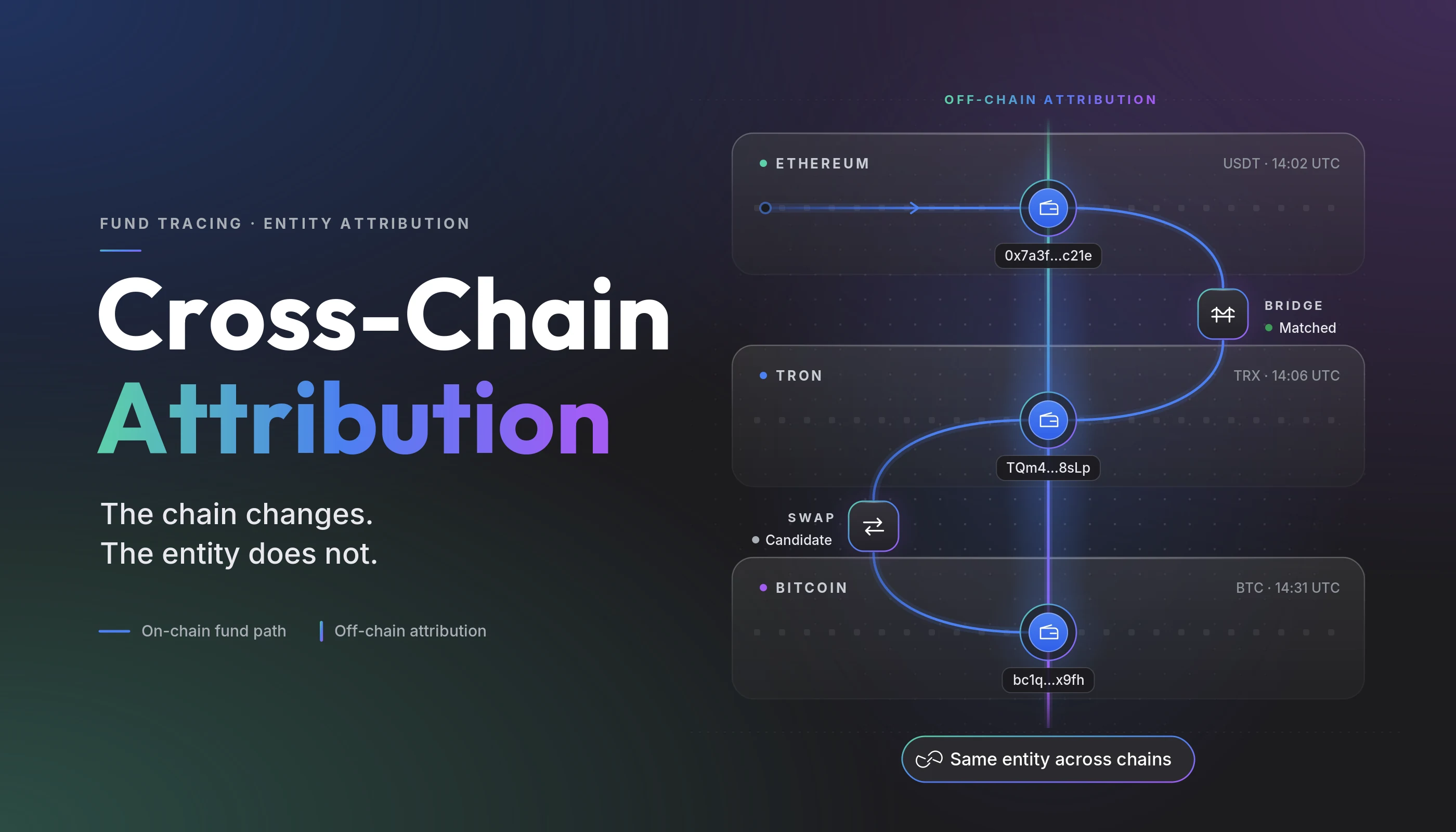
Cross-chain attribution is the work of keeping track of who controls funds as they move from one blockchain to another. Investigators match each bridge or swap deposit to its payout on the next chain, then link the wallets on every chain to one entity. When the matching gets ambiguous, off-chain attribution keeps the entity in view.
Chain hopping is now standard in large thefts. When the FBI attributed the February 2025 Bybit theft to North Korea's TraderTraitor actors, its public service announcement said the actors had converted some of the stolen assets "to Bitcoin and other virtual assets dispersed across thousands of addresses on multiple blockchains." After the October 2026 Binance theft, the FBI warned that the stolen assets were expected to be laundered further "using DeFi and instant swap services."
The technique is older than either case. In the Bitfinex laundering case, the Justice Department listed conversion into anonymity-enhanced currencies, "a practice known as chain hopping," among the methods used to obscure the trail.
What is cross-chain attribution?
Cross-chain attribution means following funds across more than one blockchain while keeping track of the entity behind them. It has two parts: linking each hop, so you know which payout on chain B came from which deposit on chain A, and linking the wallets on every chain to the same controller.
Tracing on a single chain is a matter of reading one ledger. Cross-chain work means reading several ledgers that know nothing about each other, plus the services that move value between them.
What is chain hopping and why do launderers use it?
Chain hopping is moving funds from one blockchain to another, often swapping the asset at the same time, to break the trail. Launderers use it because a deposit on one chain and a payout on another are two separate transactions on two separate ledgers. Nothing on either ledger records that they belong together.
The usual routes:
- Bridges. A contract locks or burns an asset on one chain and releases or mints an equivalent on another.
- Cross-chain swap services. The user sends one asset on one chain and receives a different asset on another.
- Centralized swap services. A custodial service takes the deposit and pays out from its own wallets, so the on-chain link stops at the service.
- DEX swaps between hops. Changing the asset on each chain, so the thing being traced keeps changing.
Each hop adds a new chain, often a new asset and usually a fresh wallet at the far end. We describe the cross-chain hop as one of the four walls in When Crypto Tracing Hits a Wall.
How do investigators match a bridge deposit to its payout?
Investigators match a bridge deposit to its payout by comparing the fields both transactions share. The deposit and the payout are separate, but they are not random: the asset, the amount after fees, the timing and often a transfer identifier line up.
- Route. Confirm which chains and assets the service supports, and which contracts handle deposits and payouts.
- Amount after fees. The payout should equal the deposit minus the service's fee and any price movement in a swap.
- Time window. Payouts usually arrive within minutes. Narrow the search to the service's normal settlement time.
- Transfer ID. Many bridges record a message or transfer identifier on both sides. Where it exists, it is the strongest single match.
- Recipient behaviour. The receiving address is often fresh and often moves funds on quickly, in the same pattern as earlier hops.
Record which fields matched for every hop. A hop matched on a transfer ID is a strong link. A hop matched only on amount and time is a candidate.
Where does cross-chain tracing lose the trail?
Cross-chain tracing loses the trail where several payouts could fit the same deposit, or where the hop passes through a service that pays out from shared wallets.
- Busy routes. On a popular bridge, many transfers of similar size settle in the same window. Amount and timing alone can leave several candidates.
- Small batches. Splitting funds into many small hops multiplies the matching work and makes each match weaker.
- Custodial swap services. When a service pays out from its own pool, the link between deposit and payout lives in the service's records, not on any chain.
- Privacy coins and mixers. A hop into a privacy-focused chain or a mixer removes the visible link entirely. The Tornado Cash investigation playbook covers that case.
- Speed. Automated laundering can cross several chains in hours, faster than manual matching can keep up.
At each of these points the funds are still moving. What the ledger stops showing is which wallet on the new chain belongs to the same actor.
How does off-chain attribution persist across chains?
Off-chain attribution persists across chains because it does not depend on any on-chain connection between wallets. A wallet on Ethereum and a wallet on Tron controlled by the same entity can be linked even when no bridge transaction connects them.
This is the layer Addressable Investigations built Spectra around. It persists as actors change wallets, and changing chains is just another way of changing wallets. What it produces is leads and digital evidence: wallets on different chains connected to the same entity, region-level attribution that narrows the jurisdiction, and time-stamped records structured for legal proceedings.
The two methods support each other. Hop matching shows how the funds moved. Off-chain attribution shows that the wallets at each end belong to the same entity, which turns a candidate match into a stronger one. For the wider picture, see On-Chain vs Off-Chain Analysis and How to Link Multiple Crypto Wallets to the Same Owner.
What should a cross-chain case file include?
A cross-chain case file should document the path on every chain, the evidence for every hop and the confidence of each link, so a reviewer can follow the money and check each step.
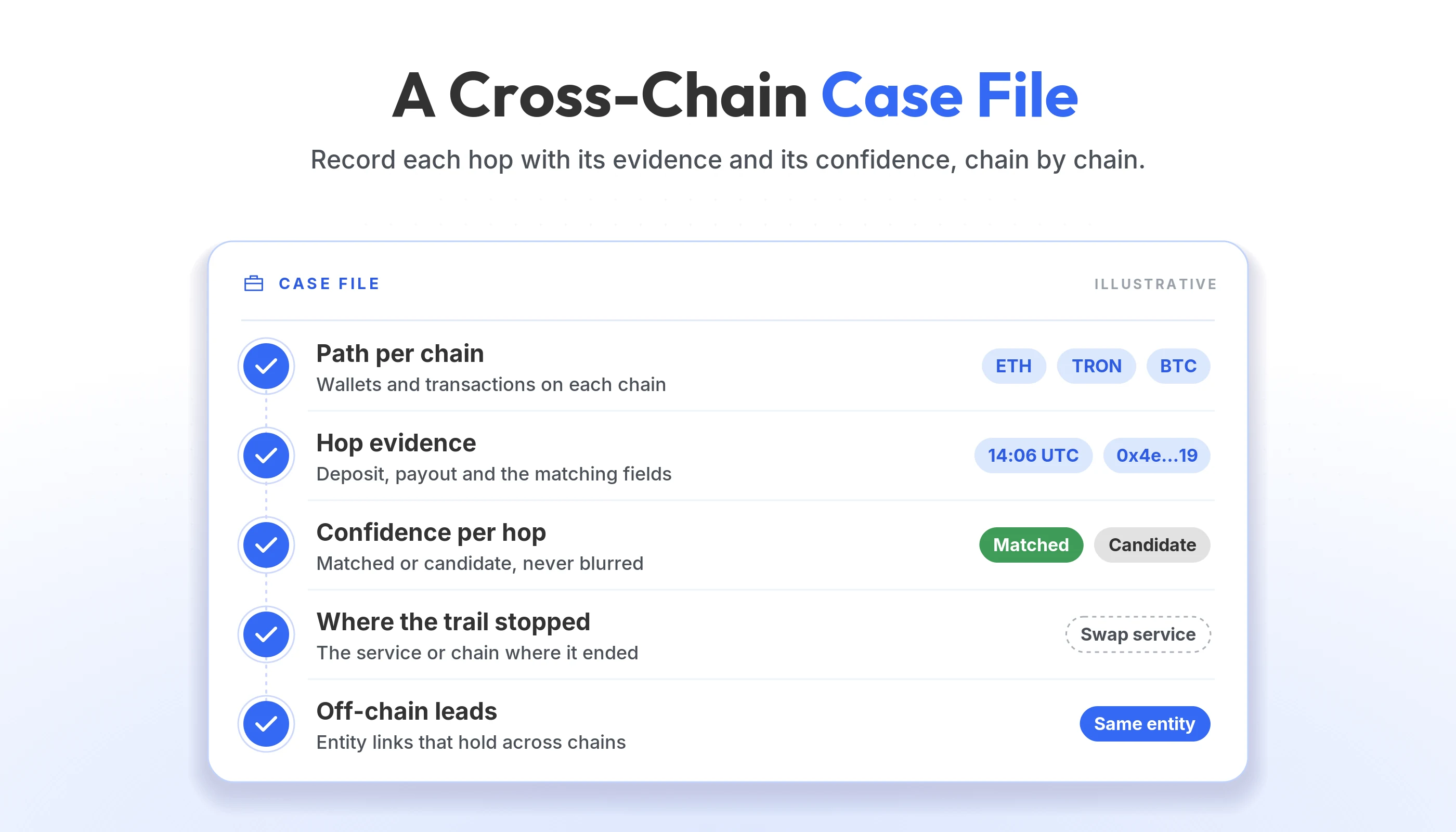
- Path per chain. The wallets and transactions on each blockchain, in order.
- Hop evidence. For each hop, the deposit, the payout and the fields that matched.
- Confidence per hop. Matched on a transfer ID, matched on amount and time, or candidate only.
- Where the trail stopped. The service, chain or mixer where matching ran out, and what records could be requested from it.
- Off-chain leads. Wallets on different chains linked to the same entity, with the time-stamped records behind each lead.
Teams running criminal investigations and token recovery increasingly see this structure in every large case. When a hop ends at a fresh address, the next step is in Fresh Wallet Investigations.