Fresh Wallet Investigations: How to Work a Wallet With No History


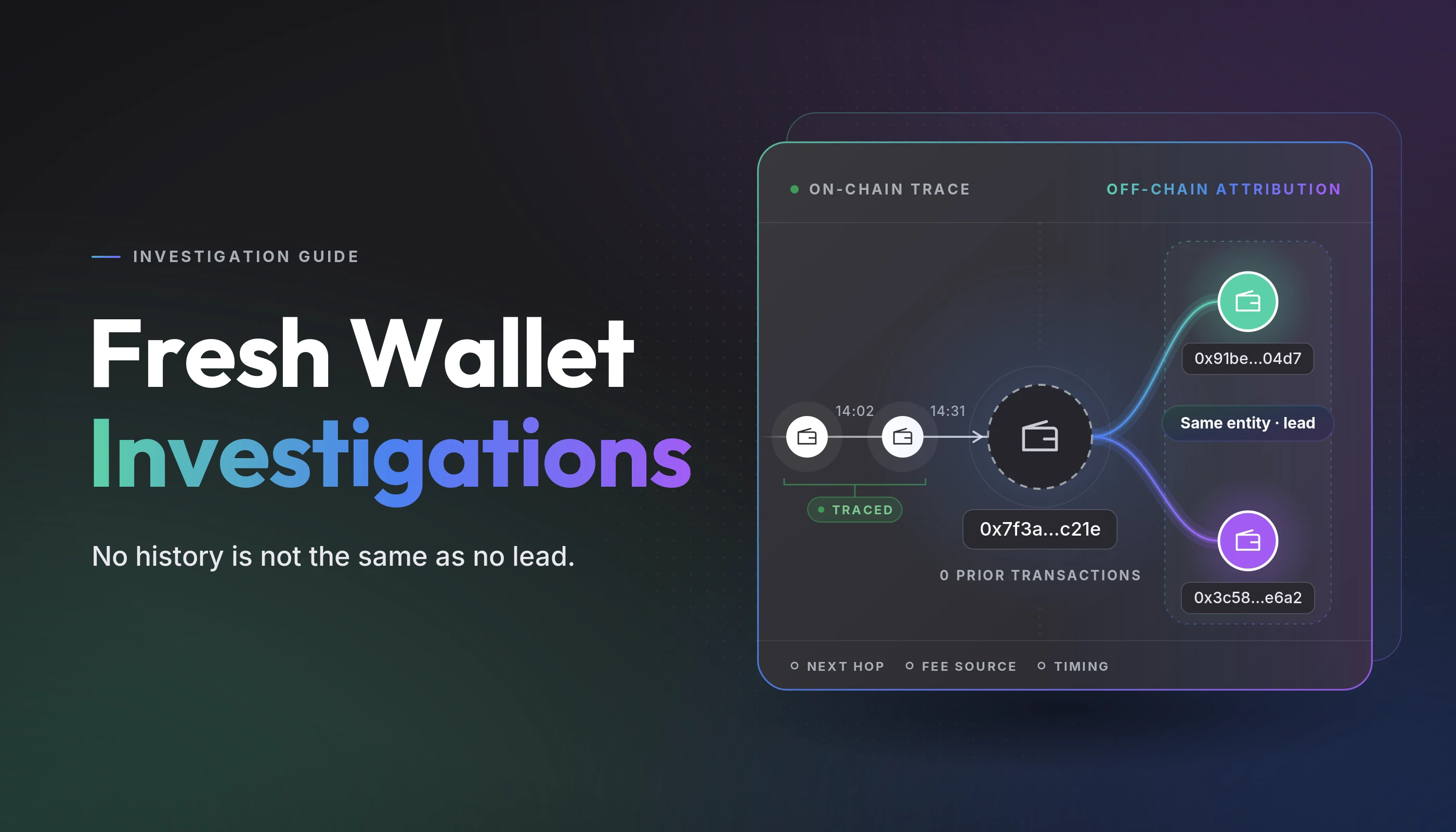
A fresh wallet is an address with no history before the traced funds arrive. It gives clustering nothing to link and sits on no screening list. A fresh wallet investigation still has three moves: follow what the wallet does next, read who funded it, and use off-chain attribution, which needs no history, to link it to an entity.
Fresh wallets are not an edge case. When the FBI attributed the February 2025 Bybit theft to North Korea's TraderTraitor actors, its public service announcement said the stolen assets were "dispersed across thousands of addresses on multiple blockchains." In May 2025, a federal indictment in a $263 million theft case described laundering through mixers and exchanges using peel chains and pass-through wallets. And in the Binance theft of October 2026, the FBI published hundreds of addresses tied to the laundering and urged the industry to block them.
Every one of those addresses was new at some point. This guide covers how to work them.
What is a fresh wallet in a crypto investigation?
A fresh wallet is an address that had no activity before it received the funds under investigation. Creating one is free and takes seconds, so an actor can use a new address for every hop, every batch or every victim.
Investigators also meet a few close relatives:
- Pass-through wallets: addresses that receive funds and forward them within minutes, then go quiet.
- Peel chains: a sequence of fresh addresses, each sending a small amount out and passing the rest to the next new address.
- Dormant wallets reactivated: old addresses with no recent history, which behave like fresh ones for clustering purposes.
The common feature is the same: no past to analyse. The wallet starts its life inside your case.
Why do launderers use fresh wallets?
Launderers use fresh wallets because every new address resets the work an investigator has to do. Each one is a new node to trace, a new set of transactions to read and a new address that no screening list contains yet.
Splitting funds across fresh addresses also keeps individual amounts small, which helps them pass through swap services and exchanges with less scrutiny. When the operation is automated, an actor can create addresses faster than any team can review them. Public reporting on the October 2026 Binance theft described thousands of seemingly automated transactions moving and swapping the funds within days.
The point of the pattern is volume, not invisibility. Splitting into fresh addresses adds work for the investigator. It does not, on its own, make the funds untraceable.
Why does a wallet with no history stall blockchain analytics?
A wallet with no history stalls blockchain analytics because the main attribution methods need past behaviour. Clustering heuristics link addresses by how they have transacted together. Tags name addresses that have interacted with known services. A fresh wallet has done neither.
Screening hits the same wall. Sanctions and blocklists are built from addresses already observed. The US Treasury says plainly that OFAC's digital currency address listings "are not likely to be exhaustive." A new address controlled by a listed actor will not match until someone adds it.
So the ledger still shows the funds arriving and leaving. What it no longer shows is who controls the wallet. That is the same failure point we mapped as one of the four walls in When Crypto Tracing Hits a Wall.
What can investigators still learn on-chain from a fresh wallet?
Investigators can still learn a lot on-chain from a fresh wallet, because it starts building a history the moment it is used. The useful signals are in what it does next and in how it was set up.
- The next hop. Follow the funds forward. Fresh wallets usually forward quickly, and the trail often reaches a swap service, a bridge or an exchange deposit address within a few hops.
- Fee funding. On account-based chains such as Ethereum or Tron, a new address needs the native token to pay fees before it can move tokens. The wallet that paid those fees is often controlled by the same actor, and it may have a history.
- Timing. Addresses created and used by the same script tend to move on the same rhythm: identical delays, batches at fixed intervals, activity at the same hours.
- Amounts. Round splits, identical batch sizes and consistent fee settings repeat across addresses operated by the same tool.
- Convergence. Funds that split across many fresh wallets often recombine later, at a swap, a bridge or a single deposit address.
None of these signals is proof on its own. Together they turn a single dead address into a group of addresses that behave as one operation.
How does off-chain attribution work on a wallet with no history?
Off-chain attribution works on a wallet with no history because it does not depend on transaction history at all. It does not depend on any on-chain connection between wallets, so a brand-new address is no harder to attribute than an old one.
This is the layer Addressable Investigations built Spectra around. When a fresh wallet stalls the on-chain trace, the off-chain layer can link it to other wallets controlled by the same entity. Because it persists as actors change wallets, rotating to a new address does not reset it. What it produces is leads and digital evidence: an investigative starting point when the chain goes quiet, region-level attribution that narrows the jurisdiction, and time-stamped records structured for legal proceedings.
We explain how the two layers divide the work in On-Chain vs Off-Chain Analysis.
What does a fresh-wallet investigation workflow look like?
A fresh-wallet investigation works the ledger first, then brings in off-chain attribution where the ledger stops naming anyone. Four steps cover most cases.
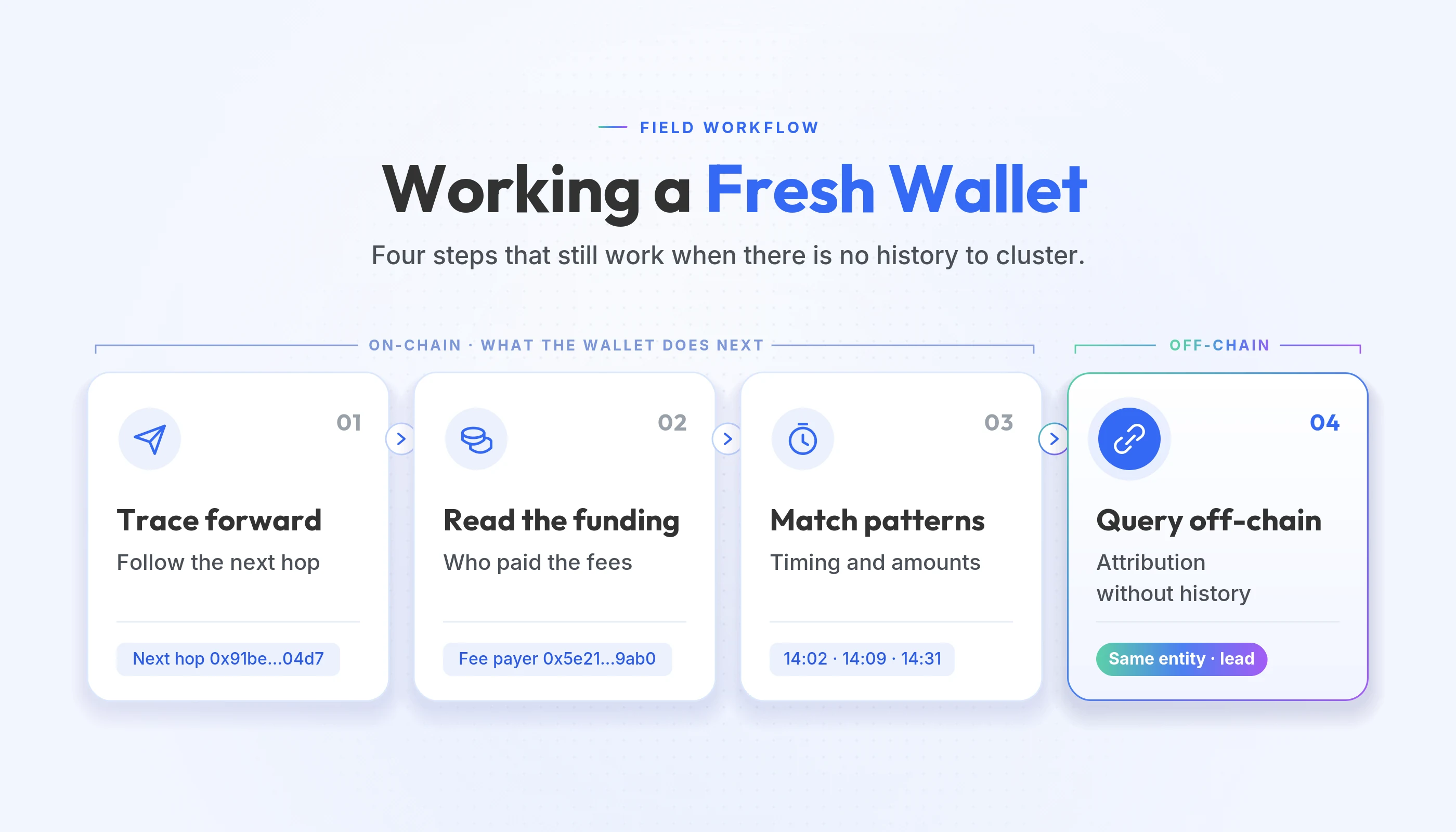
- Trace forward. Follow the funds from the fresh wallet to the next hop, and keep going until you reach a service, a bridge or a quiet address.
- Read the funding. Find who paid the fees for the fresh wallet and whether that funder has a history or a link to a known service.
- Match patterns. Group fresh wallets that share timing, amounts, fee settings or a funder, and treat the group as one operation.
- Query the off-chain layer. Run the wallets that stalled. If they resolve to the same entity, the case continues with a lead and a likely jurisdiction, ready to confirm through legal process.
The same order applies whatever the case type. Fresh wallets turn up in pig butchering investigations as victim-specific deposit addresses, and after mixers, as the Tornado Cash investigation playbook shows. Teams running criminal investigations and token recovery meet them in almost every file.